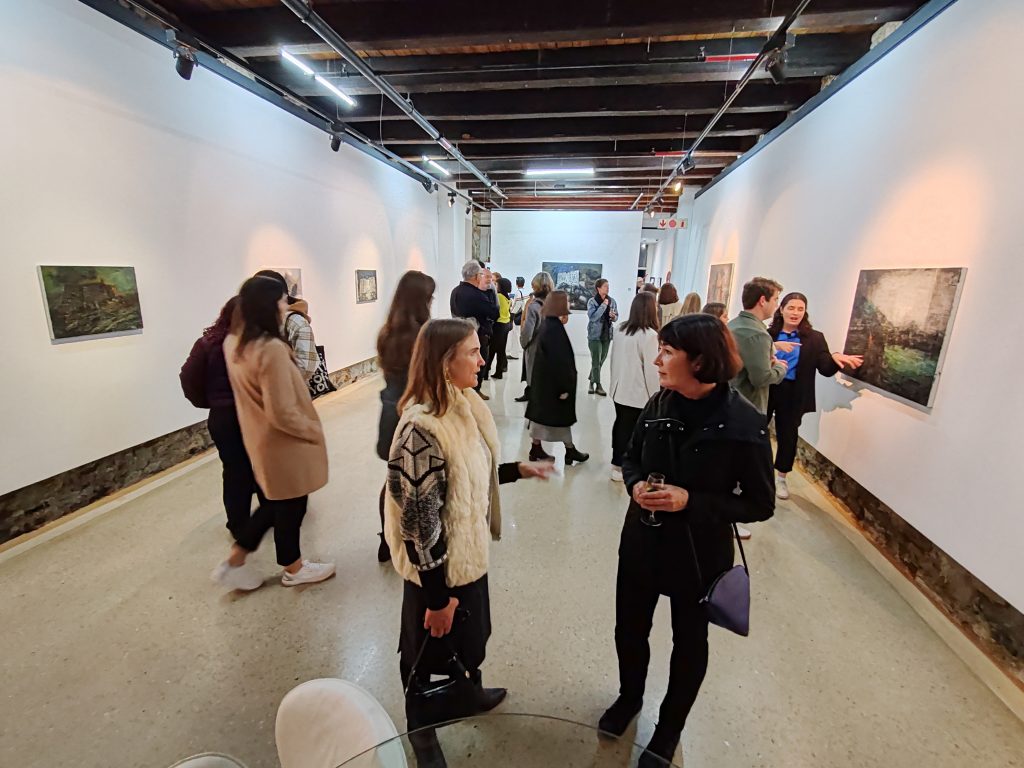
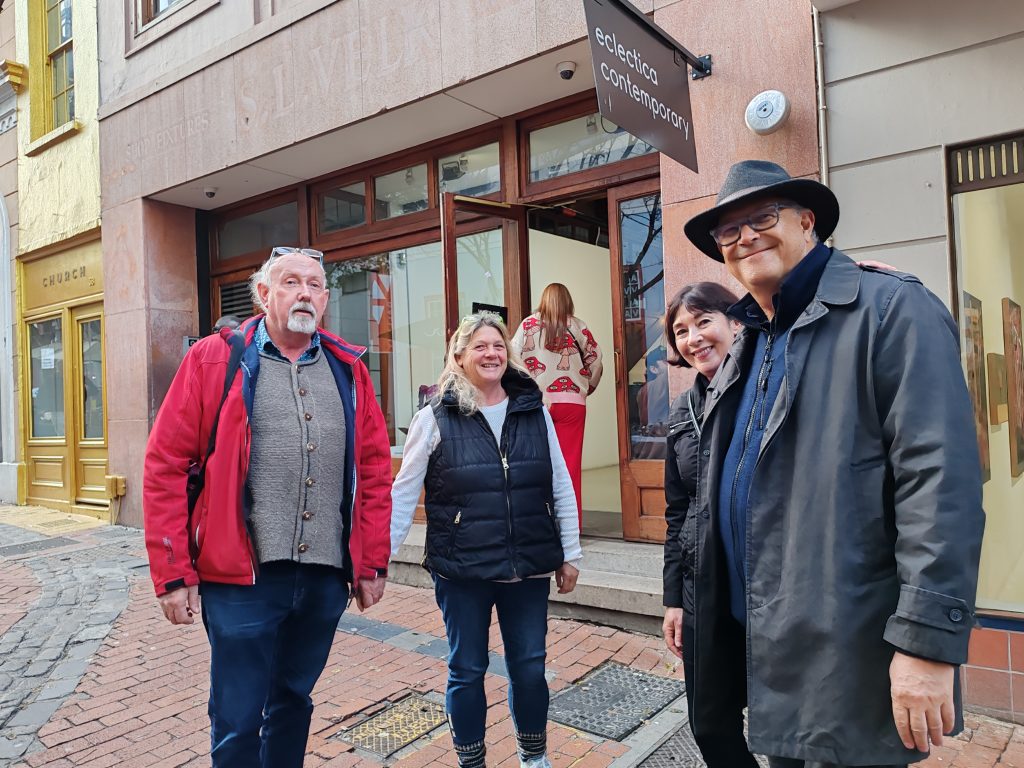
Review by Richard Kilpert, edited by Di Kilpert
Greywacke, an exhibition of oil paintings on canvas by Jacobus Kloppers at Eclectica Gallery, Cape Town, June 2024, https://eclecticacontemporary.co.za/greywacke/
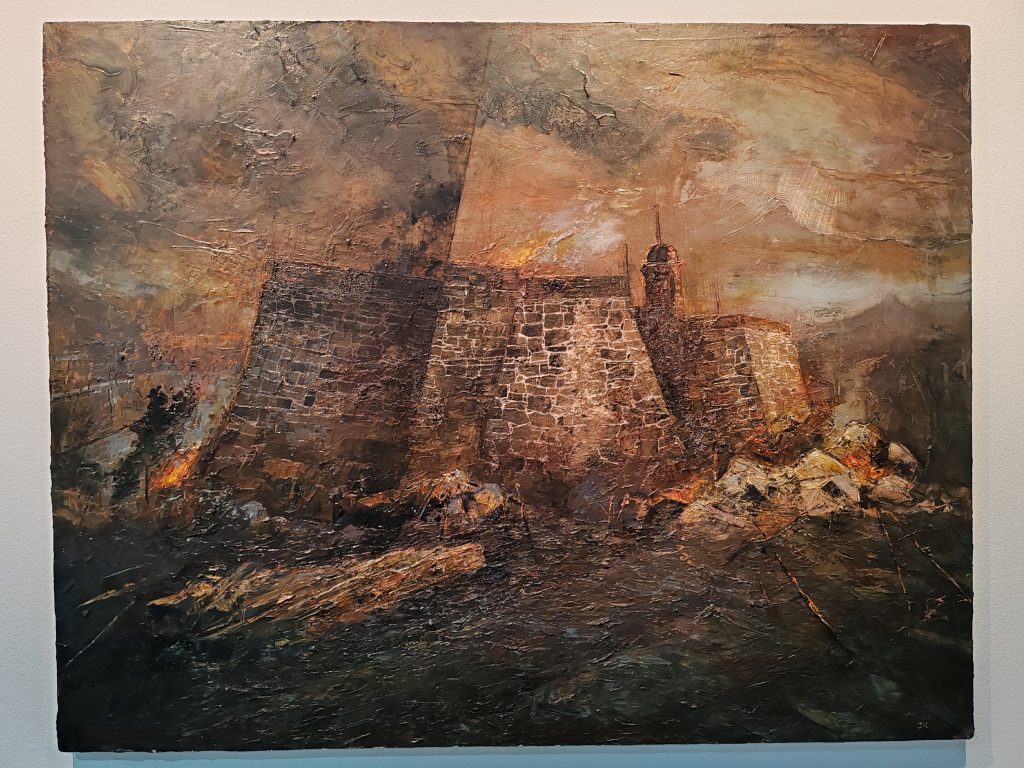
Guiding foreign visitors around the studios, galleries and museums of Cape Town, I often have to brush up my knowledge about South Africa’s past. Most recently I’ve been rediscovering the Castle of Good Hope, from whose walls of Cape Peninsula sandstone or ‘greywacke’ this exhibition draws its title.
In these visually stunning and masterly paintings, Jacobus Kloppers presents a vision of the history entombed in this colonial fortress, reflecting 400 years of European branding etched into the Cape psyche. The turbulent history of the Cape materialises in these astonishing landscapes.
What influences might we see here? I was reminded of Turner’s boiling skies and tormented seas. Along with fellow Romantics, such as Gericault, and Herman Melville, Goethe and Mahler in other media, Turner had the ability to transmit the sublime. Reacting against the rationalism of the classical tradition, these visionaries ranked emotion over reason and freedom over form, preferring to venture into the unknown rather than remain in a safe harbour.
What do we mean by sublime? In his Treatise on Aesthetics, Edmund Burke made this distinction: the beautiful was whatever was well-formed and aesthetically pleasing, according to the Grecian ideal of the time, while the sublime was whatever has the power to compel and destroy. The sublime was a well of passion. It was awe at human littleness in the face of the grand spectacle of nature, momentous events and the passing of time. In Turner’s day, people loved paintings of historic events. They wanted not just a landscape or seascape, but Hannibal Crossing the Alps, or the Battle of Trafalgar. Kloppers’ paintings are in this tradition, though only a few of his titles ground the vision in the particular: Battlefield, Tower of Babel.
Some biographical detail of the artist will help us understand the paintings. I met Jacobus (‘Kobus’) Kloppers in 1995 in Grahamstown (now Makhanda) when he laboured under a Nietzschean moustache and was the phlegmatic teacher at the Johan Carinus Art Centre. He spent his private time painting and playing the accordion in a local band. His paintings were meditations on land, engaging the mythology of that frontier place via elemental symbols. Becoming more and more grounded in the landscape of the Karoo, his paintings conjured monuments out of its pastoral scenes.
At the turn of the millennium, he vanished into the Camdeboo and lived with a poet for a few years to stare at the stars. In 2005 he could be found orbiting Johannesburg. With all this movement, his subject matter moved too. I remember standing in his studio in Kensington and seeing a vast highway vista with spontaneous swipes of paint where his son Joab, all of two years old, had collaborated with him. The road paintings evolved, becoming cinematic panoramas painted on reclaimed road signs, seen in a rearview mirror.
Around 2010 the electric storms on the Vaal Dam blew Kobus the sailor to Cape Town, and on the Atlantic coastline he was confronted with the epic spectacle that is Table Bay. With windows looking onto that storied expanse of sea, who could not be marked? He set sail on the outgoing tide at dawn to find new colours and marine textures to illuminate our past.
What audience is there for a history painter today? Our society is fixated on the present. Artists’ subject matter is narcissistic. Viewers accustomed to the immediate and the trendy may struggle to make sense of older, deeper narratives. A Kloppers painting takes months and even years to emerge from the studio. Time is reflected in his layered perspectives, the forensic logic of his oil and linseed distilling landmarks to their essence, presenting us with a human-less visual moment which carries centuries of traffic
In an age of doom-scrolling, these sublime paintings invite us to meditate on our place in time outside of our transient political moment, to travel in time and measure our actual power in relation to the unstoppable march of history.